Sell My Car Hub

How to fill out Utah TC-569C

The small-estate route, on one page. Where an owner has died and the estate is modest enough, a survivor swears to five facts and the vehicle transfers without probate and without a court order. It is the only form in the Utah private-seller set with a notary block on the applicant's own side of the page, and the five facts it certifies are not negotiable - each one is a condition in Utah Code 75-3-1201 rather than an assurance the Division has invented.
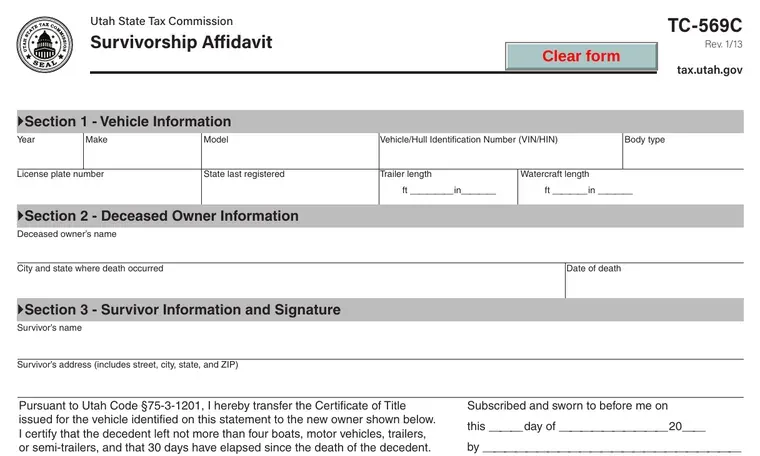
Written against TC-569C (Rev 1/13), issued under Utah Code 75-3-1201. The affidavit certifies that the transfer will not prejudice the creditors of the decedent. That is a real statement about a real estate, and it is why the Division asks for the value of everything subject to administration rather than only for the value of the car.

Two documents, and they are not the same thing. Take the blank TC-569C from the files.tax.utah.gov copy so you get the revision that is current today.

Filled in

What a completed one looks like

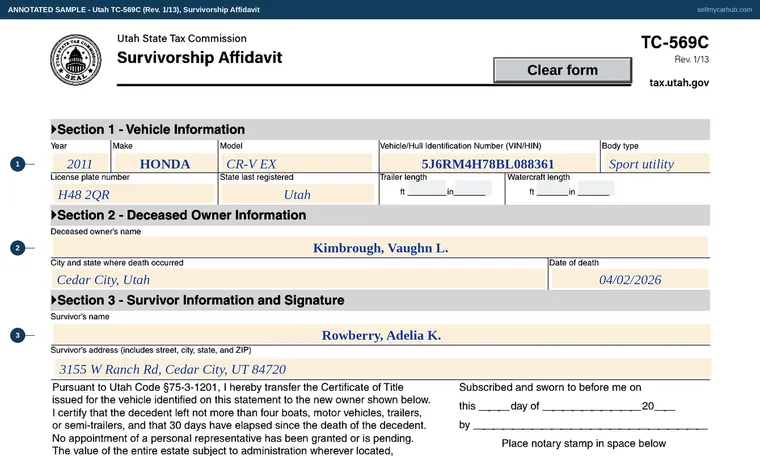
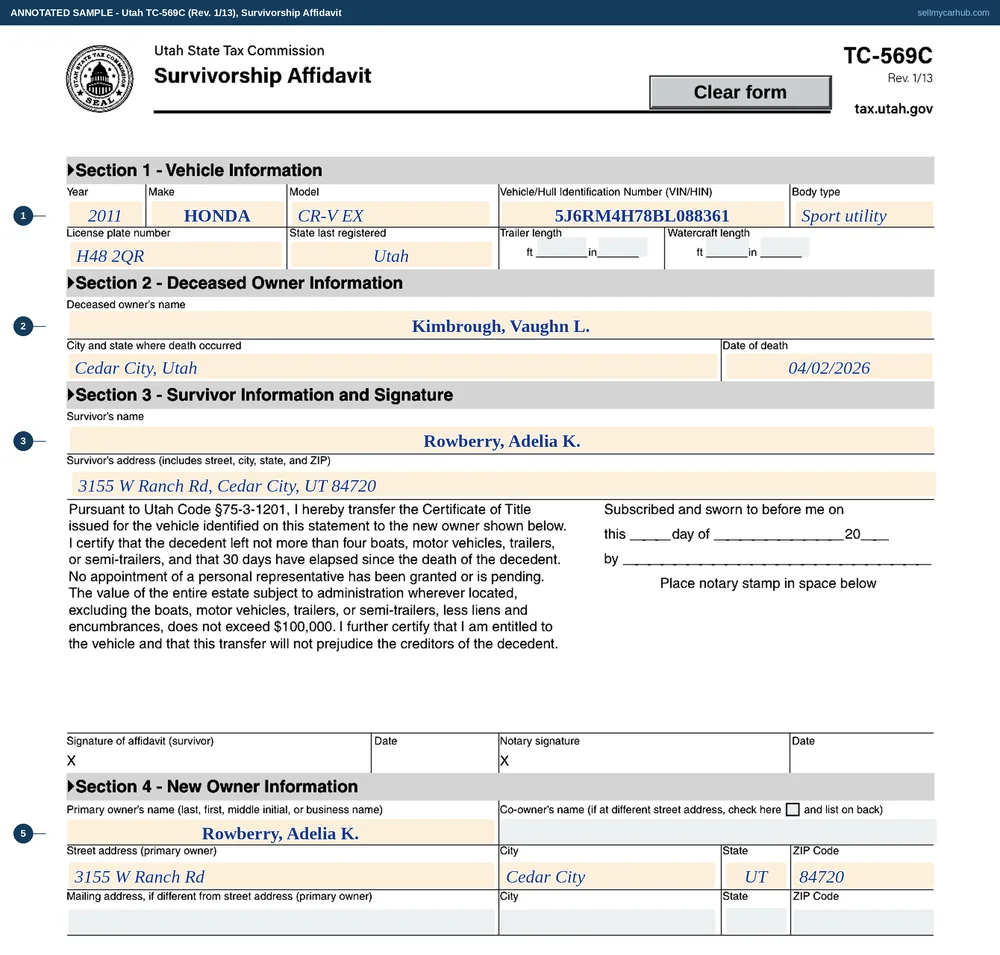
This is the actual TC-569C, rendered from the PDF the Utah State Tax Commission, Motor Vehicle Division publishes and completed end to end: letterhead, every field, and the blocks at the foot.

Utah form TC-569C filled in: a 2011 Honda CR-V with identification number 5J6RM4H78BL088361 belonging to Vaughn L. Kimbrough, who died in Cedar City on 2 April 2026, transferred by survivor Adelia K. Rowberry, with the notarial block completed and the new owner recorded.
The five certifications in the middle of the page are the whole of the estate test. The notary block beside the survivor's signature is the only sworn block a Utah seller normally meets.
Field by field

Every line, in the order you meet it

  1. 1
    You fill this in

    Section 1, the vehicle

    Year, make, model, identification number, body type, plate and the state it was registered in.

    Watch out: Take the details off the certificate of title if you can find it. If you cannot, the duplicate title application route runs in parallel and the survivor signs that instead.

  2. 2
    You fill this in

    Section 2, the decedent

    The name as the title prints it, the city and state where the death occurred, and the date of death.

    Watch out: The date of death is what the thirty-day wait is measured from, and it is the first thing a clerk checks against the calendar.

  3. 3
    You fill this in

    Section 3, the survivor

    Your own name and address, above the block of certifications.

    Watch out: Read all five certifications before writing anything. If any one of them is untrue the route is probate, and finding that out at the notary's desk is expensive.

  4. 4
    You fill this in

    The signature, and the notary

    The survivor signs and a notary subscribes and swears the affidavit on the same line.

    Watch out: Sign in front of the notary. This is the only document in the Utah seller's set where that is a requirement rather than a habit.

  5. 5
    The buyer fills this in

    Section 4, the new owner

    Who the vehicle is going to, with an address and a co-owner block if two people are taking it.

    Watch out: If the survivor is keeping the car, they go here as well as in Section 3. If it is being sold, the buyer goes here and the survivor still signs the ownership document in the prescribed as-survivor format.

At a glance

What goes where

On the formWhat to put in it
Section 1 - Vehicle InformationYear, make, model, identification number and body type, with the trailer and watercraft length boxes the 569-series always carries.
License plate number and State last registeredThe registration the affidavit will end.
Section 2 - Deceased Owner InformationThe decedent's name, the city and state where the death occurred, and the date of death.
Section 3 - Survivor InformationThe survivor's name and a single wide address rule.
The transfer sentencePursuant to Utah Code 75-3-1201, I hereby transfer the Certificate of Title issued for the vehicle identified on this statement to the new owner shown below.
The four-vehicle limitThat the decedent left not more than four boats, motor vehicles, trailers, or semi-trailers.
The thirty-day waitThat 30 days have elapsed since the death of the decedent.
The no-representative conditionThat no appointment of a personal representative has been granted or is pending.
The estate ceilingThat the value of the entire estate subject to administration wherever located, excluding the boats, motor vehicles, trailers, or semi-trailers, less liens and encumbrances, does not exceed $100,000.
The entitlement certificationThat the survivor is entitled to the vehicle and that this transfer will not prejudice the creditors of the decedent.
Signature of affidavit (survivor) and DateMarked with a printed X, beside the notarial block.
Subscribed and sworn to before me on this ___ day of ___ 20___ by ___The notary's acknowledgement, with a marked space beneath it reading Place notary stamp in space below.
Section 4 - New Owner InformationWho the vehicle is going to - which may be the survivor, and may be a buyer.

What gets this one rejected

Rules that decide whether it is accepted

Every line here was read off TC-569C (Rev 1/13) itself — the PDF is here — and off the Utah State Tax Commission, Motor Vehicle Division pages. This is plain-language help with a form, not legal advice, and where our wording and the agency's differ, theirs governs.

Back to all Utah seller paperwork, or what selling a car in Utah involves.

Want the paperwork handled instead?

Get My Instant Offer → Online · about 2 minutes · free

Or send the details — we'll come to you

Settling an estate and the car is the last thing on the list? We handle the paperwork end and collect from the driveway.

or call/text (877) 405-1808