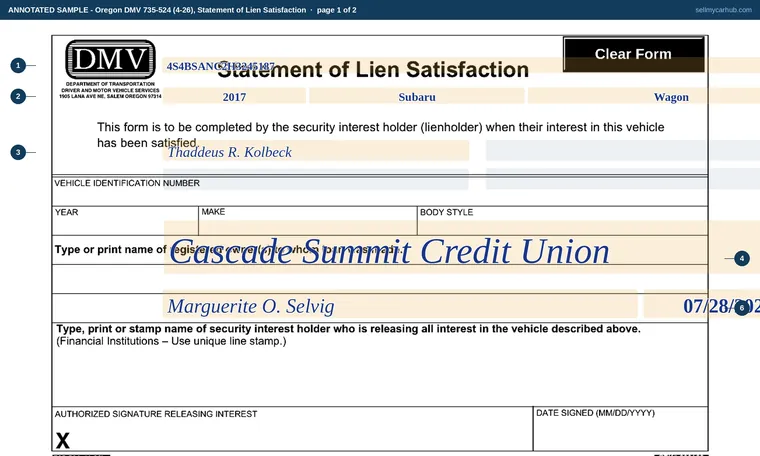
A half-page release, signed by the lender rather than by you, for the case where the loan is paid off and the certificate does not show it. Oregon's ordinary route is different — the security interest holder signs the front of the title itself, on one of two lines marked SIGNATURE AND COUNTERSIGNATURE OF SECURITY INTEREST HOLDER OR LESSOR RELEASING ALL INTEREST — so this form is what you ask for when the lender no longer has the title, or has it and will not part with it, or released years ago and left the record standing.
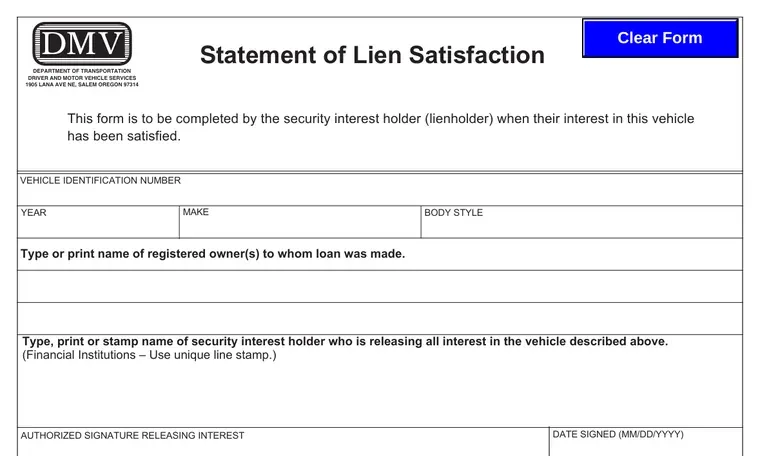
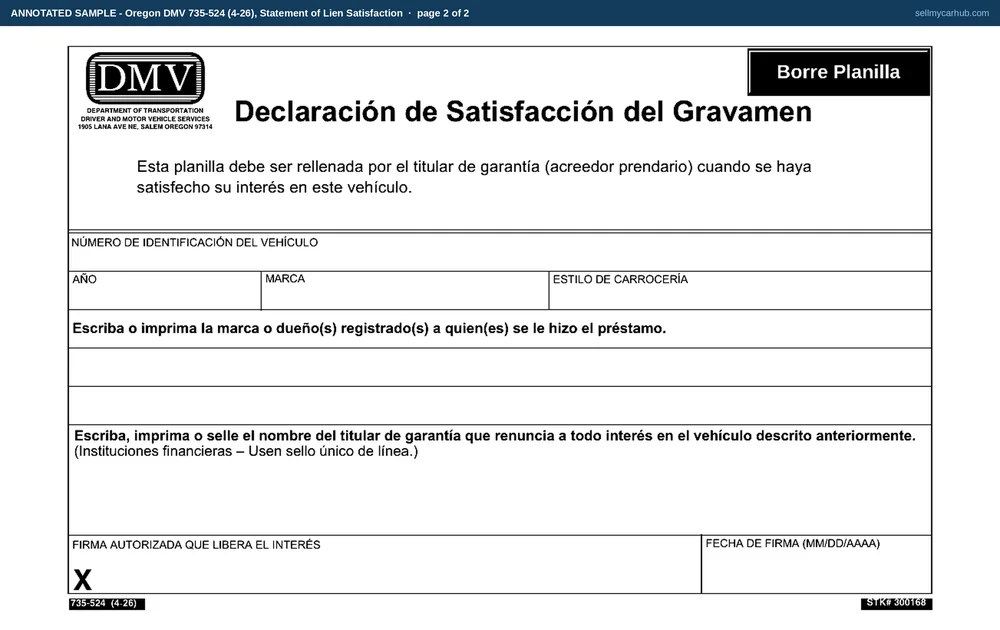
Written against 735-524 (4-26), issued under ORS 803.097 and DMV Title & Registration Handbook Chapter E. Revised April 2026 and printed in English on the first page and Spanish on the second — they are the same form and either face is acceptable. Check the record before you list the car, not after a buyer asks.
Two documents, and they are not the same thing. Take the blank 735-524 from the oregon.gov copy so you get the revision that is current today.
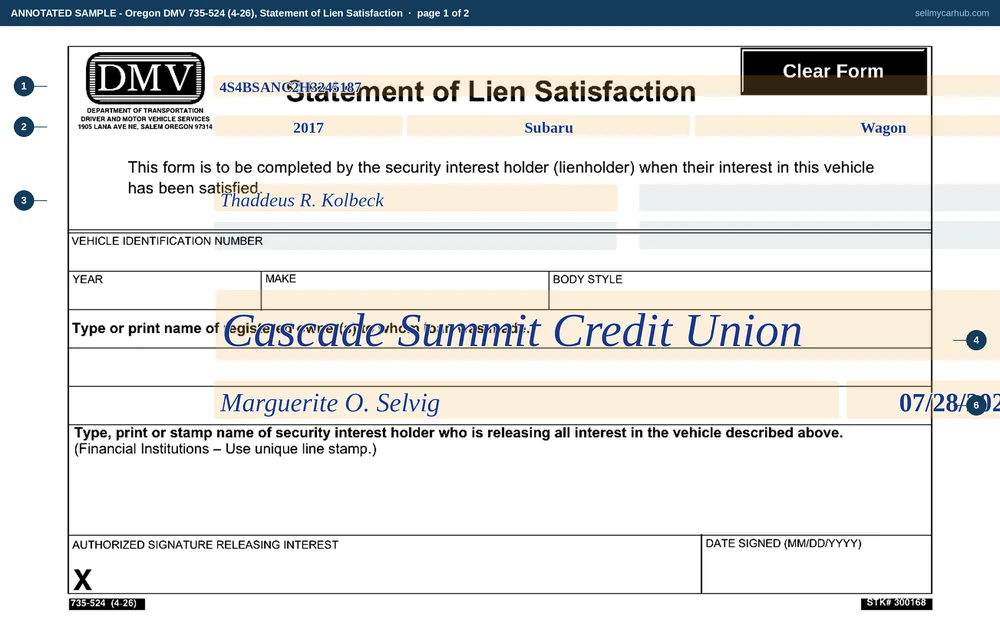
This is all 2 pages of the actual 735-524, rendered from the PDF the Oregon Department of Transportation, Driver and Motor Vehicle Services Division publishes and completed end to end: letterhead, every field, and the blocks at the foot.
The full-width box at the top of the block.
Watch out: This is the field that ties the release to a record. A release of interest with no vehicle identification on it is not one DMV can use, whoever signed it.
Three boxes on the second row, describing the vehicle as the title describes it.
Watch out: Body style is the certificate's own word — the front of an Oregon title has a STYLE box, and copying from there avoids an argument about what a wagon is.
The borrower, not the lender. Usually you.
Watch out: If the loan was in two names and the title is in two names, both belong on this line — the release has to match the record it is clearing.
The deep block in the middle of the form, with an instruction to financial institutions to use a unique line stamp.
Watch out: A signature on its own is not a business release. The handbook wants the business name and an authorised representative's signature together, and the line stamp is how most lenders do it.
One line, marked with an X, signed by somebody with authority at the lender.
Watch out: Original ink on the copy that reaches DMV. A scan emailed to you is fine for your own peace of mind and is not the document the department will accept.
The last box on the form.
Watch out: Undated releases come back. It is one of the four things Chapter E requires of any release of interest, and it is the one lenders skip.
| On the form | What to put in it |
|---|---|
| Vehicle identification number | A full-width box across the top of the block. |
| Year, make, body style | Three boxes on the row beneath it. |
| Type or print name of registered owner(s) to whom loan was made | One wide line, and it is the owner rather than the lender. |
| Type, print or stamp name of security interest holder who is releasing all interest in the vehicle described above | A deep block, with an instruction to financial institutions in brackets: use unique line stamp. |
| Authorized signature releasing interest | One signature line marked with an X. |
| Date signed (MM/DD/YYYY) | A dated box beside the signature. |
| The Spanish face | Page two is the same form in Spanish, headed Declaración de Satisfacción del Gravamen, with the identical boxes. |
Every line here was read off 735-524 (4-26) itself — the PDF is here — and off the Oregon Department of Transportation, Driver and Motor Vehicle Services Division pages. This is plain-language help with a form, not legal advice, and where our wording and the agency's differ, theirs governs.
Back to all Oregon seller paperwork, or what selling a car in Oregon involves.