The application that gets a rebuilt car back on the road. New York will not register a vehicle whose owner has answered the damage disclosure on the certificate in the affirmative until the department has examined it for stolen parts - and this is the form that books that examination and applies for the branded certificate that follows it.
Written against MV-83SAL (10/25), issued under the NYS DMV salvage vehicle programme. Every part of this happens before the sale, not during it. A rebuilt car with no examination behind it is a car the buyer cannot register, and finding that out at the counter turns your completed sale into a refund conversation.
Two documents, and they are not the same thing. Take the blank MV-83SAL from the dmv.ny.gov copy so you get the revision that is current today, then print our MV-83SAL guide and keep it beside you while you fill theirs in.
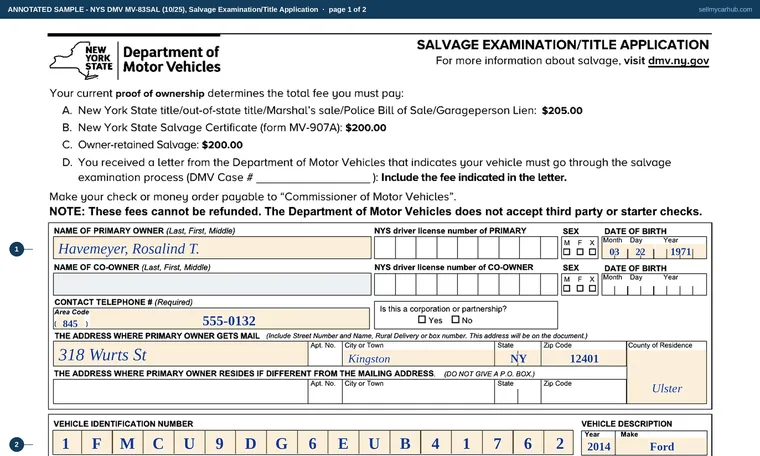
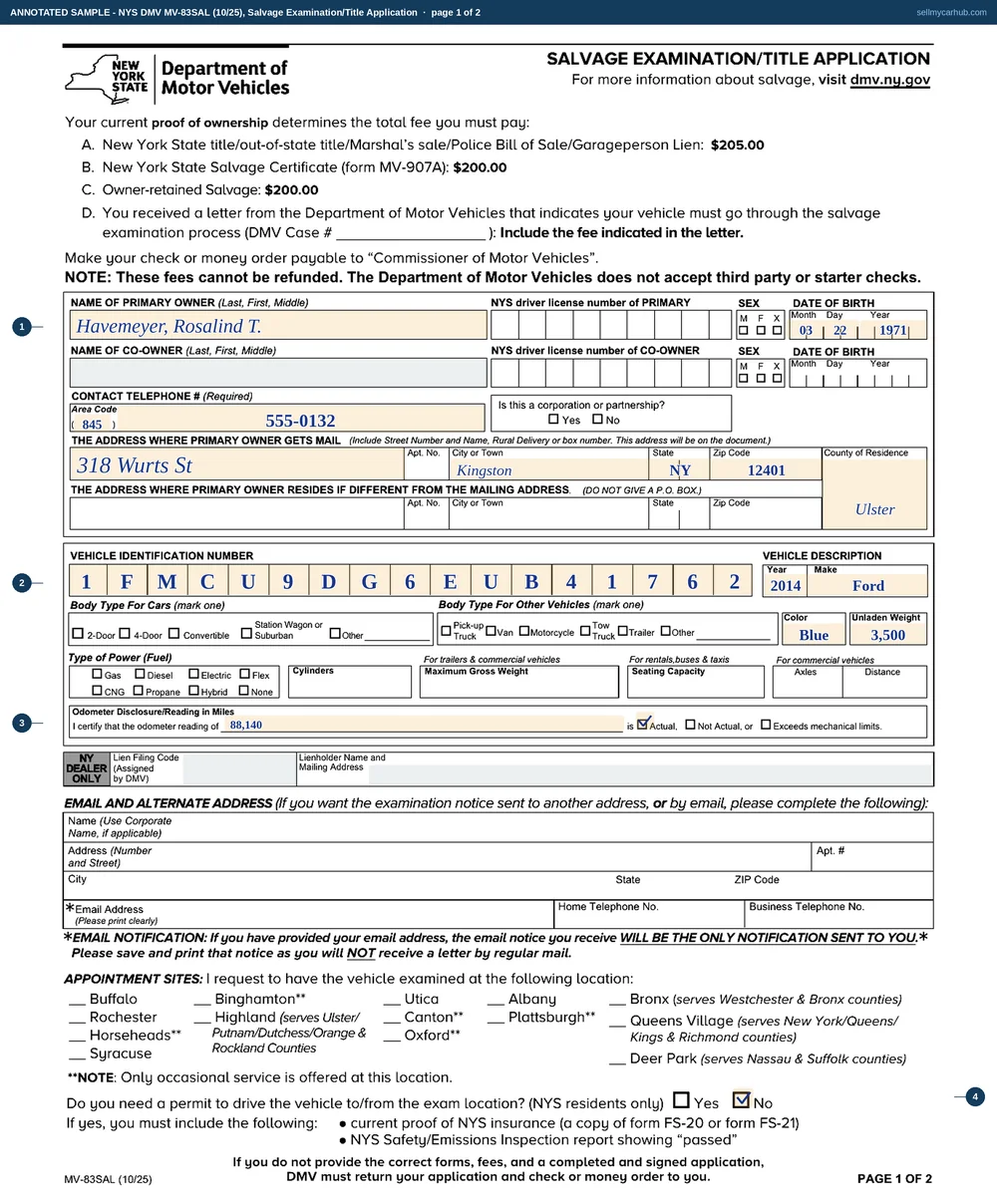
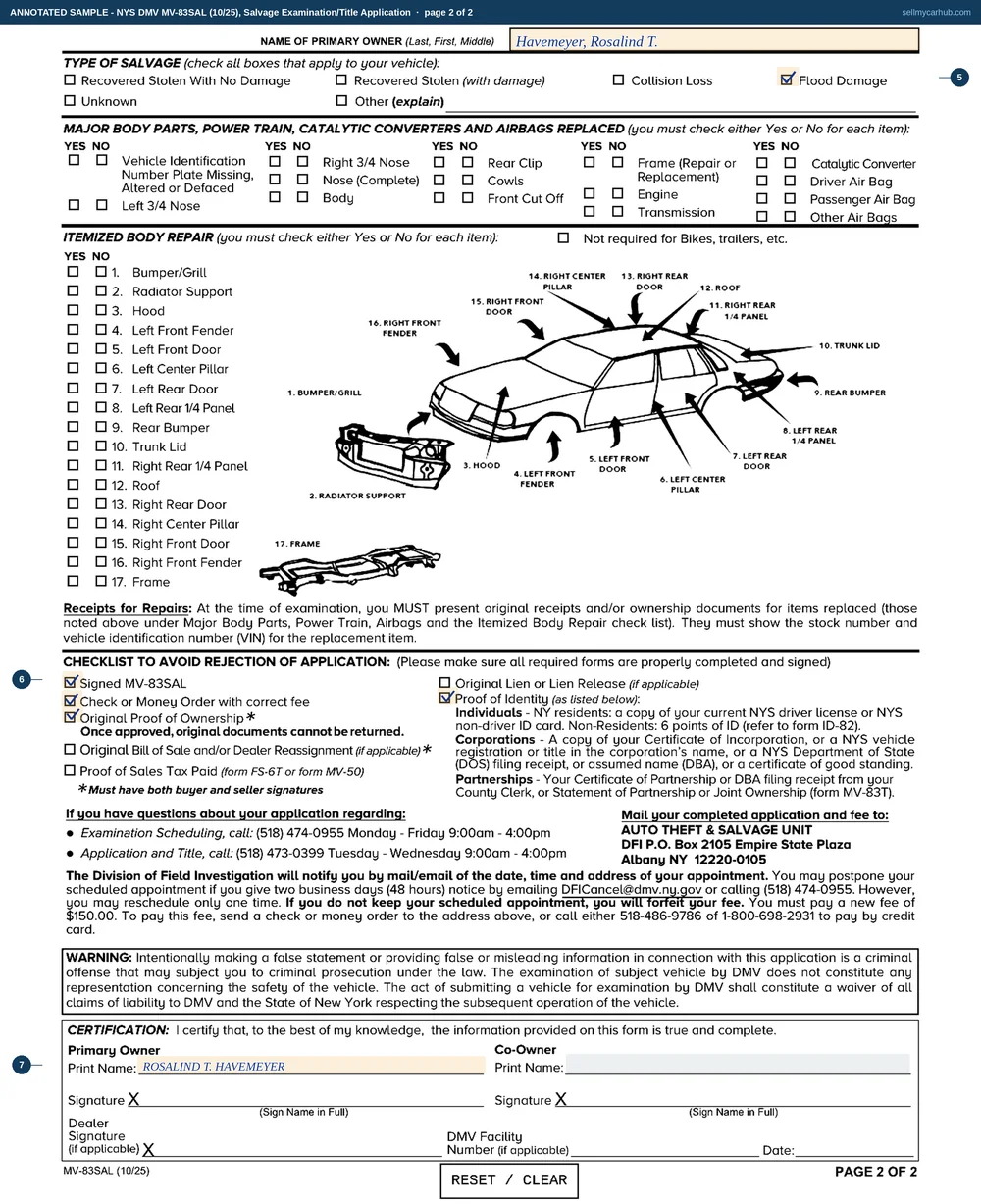
This is all 2 pages of the actual MV-83SAL, rendered from the PDF the New York State Department of Motor Vehicles publishes and completed end to end: letterhead, every field, and the blocks at the foot.
Name, driver licence number, date of birth, a contact telephone number and the address the documents will be posted to, with the county of residence.
Watch out: The telephone number is marked required for a reason: the examination is scheduled by the Division of Field Investigation, and an application they cannot query is an application that waits.
One character per printed box, then year, make, colour, weight, fuel and cylinders.
Watch out: This examination is fundamentally about whether the parts on the car are the car's own. The identification number is the anchor for every receipt you will be asked to produce.
The reading, and whether it is actual, not actual, or exceeds mechanical limits.
Watch out: A rebuilt car has often had an instrument cluster replaced. If yours has, the honest answer is not the first box, and the receipts will say so anyway.
One of fourteen examination locations, and whether you need a permit to drive the vehicle there.
Watch out: Asking for a permit means enclosing current proof of New York insurance and an inspection report showing a pass. If the car cannot pass an inspection yet, it goes on a trailer instead.
On page two: recovered stolen with or without damage, collision loss, flood damage, unknown or other.
Watch out: Flood is its own category here rather than a kind of collision loss, and it is the one buyers ask about most. Answer it accurately - the examination is looking at the car, not at the box you ticked.
Signed application, correct fee, original proof of ownership, original bill of sale, proof of sales tax paid, original lien release and proof of identity.
Watch out: Work down it physically with the envelope open. The department prints this list because posting the package back is the default outcome for anything incomplete.
Print your name in full and sign underneath it. A co-owner has their own pair of boxes beside yours.
Watch out: The warning printed directly above this block does two things: it makes a false statement a criminal offence, and it records that submitting the vehicle for examination waives any claim against the department over how the car behaves afterwards.
| On the form | What to put in it |
|---|---|
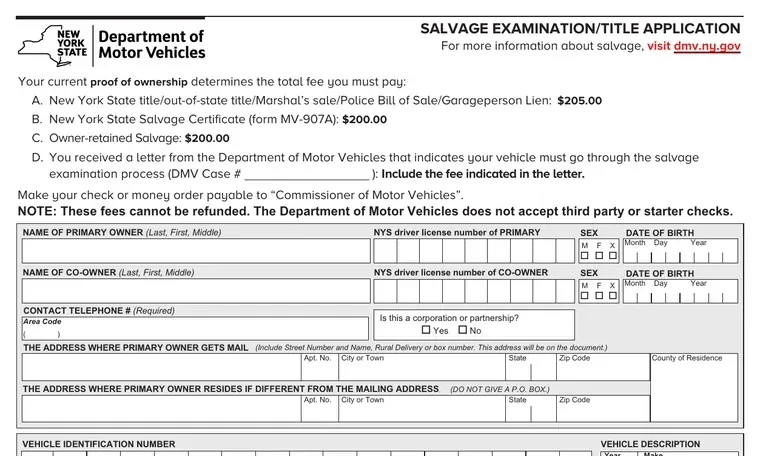
| The fee block at the head | Four lettered options, and which one you pay depends on what you are holding. A New York or out-of-state title, a marshal's sale, a police bill of sale or a garageperson lien is $205.00; a New York salvage certificate is $200.00; owner-retained salvage is $200.00; and where the DMV has written to you telling you the vehicle must go through the process, the letter names the fee. The form adds that these fees cannot be refunded. |
| Owner information | Primary owner and co-owner: name, New York driver licence number, sex, date of birth, a contact telephone number marked required, the address where the owner gets post, a residence address if it differs, and the county of residence. |
| Vehicle information | Identification number in printed boxes, year, make, body type for cars or for other vehicles, colour, unladen weight, fuel, cylinders, gross weight and seating capacity. |
| Odometer disclosure | A reading, and one of three certifications: actual, not actual, or exceeds mechanical limits. |
| Email and alternate address | Where the examination notice goes. The form warns in bold that if you give an email address, the emailed notice will be the only notification sent - so save and print it, because no letter follows. |
| Appointment sites | Fourteen locations to choose from, with notes on which counties some of them serve and which offer only occasional service. |
| Do you need a permit to drive the vehicle to the exam? | Yes or no. A yes needs current proof of New York insurance and an inspection report showing a pass. |
| Type of salvage, on page 2 | Recovered stolen with no damage, recovered stolen with damage, collision loss, flood damage, unknown, or other. |
| Major parts and itemised body repair, on page 2 | Two grids. The first asks yes or no for each of eighteen major body parts, power train components, catalytic converters and airbags. The second is a numbered diagram of seventeen body panels from bumper to frame. |
| Receipts for repairs | At the examination you must present original receipts or ownership documents for every item replaced, showing the stock number and the vehicle identification number for the replacement part. |
| The rejection checklist | Signed application, correct fee, original proof of ownership, original bill of sale, proof of sales tax paid, original lien release if applicable, and proof of identity. |
Every line here was read off MV-83SAL (10/25) itself — the PDF is here — and off the New York State Department of Motor Vehicles pages. This is plain-language help with a form, not legal advice, and where our wording and the agency's differ, theirs governs.
Back to all New York seller paperwork, or what selling a car in New York involves.