Sell My Car Hub

How to fill out Mississippi 78-011

The page an adjuster sends after a total loss: you appoint the insurance company as your attorney-in-fact for transferring ownership, applying for title, or applying for registration on the one wrecked vehicle, with full authority to sign on my (our) behalf all papers and documents. It exists so the claim can close without chasing you for every later signature - and its footnote carries a genuinely unusual rule about electronic signatures.
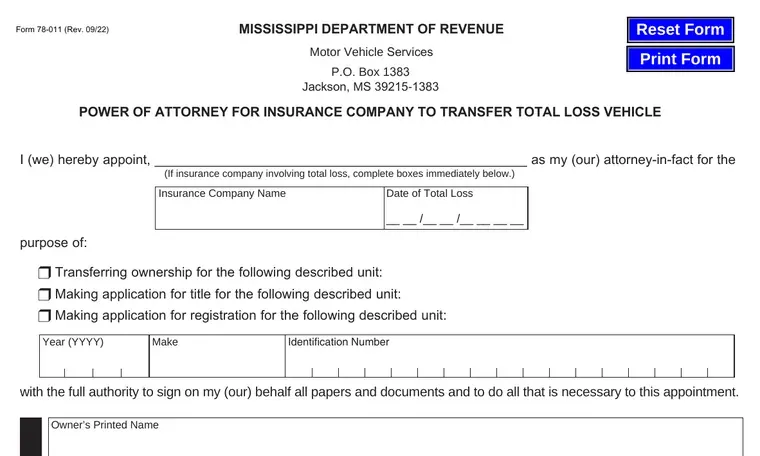
Written against 78-011 (Rev 09/22), issued under the vehicle's owner or owners, appointing the insurer as attorney-in-fact. Read the scope line before signing: this appoints the insurer for the described unit only, and the description is one VIN wide. An insurer's packet that arrives with the vehicle line blank should go back with the line filled - by you.

Two documents, and they are not the same thing. Take the blank 78-011 from the dor.ms.gov copy so you get the revision that is current today, then print our 78-011 guide and keep it beside you while you fill theirs in.

Filled in

What a completed one looks like

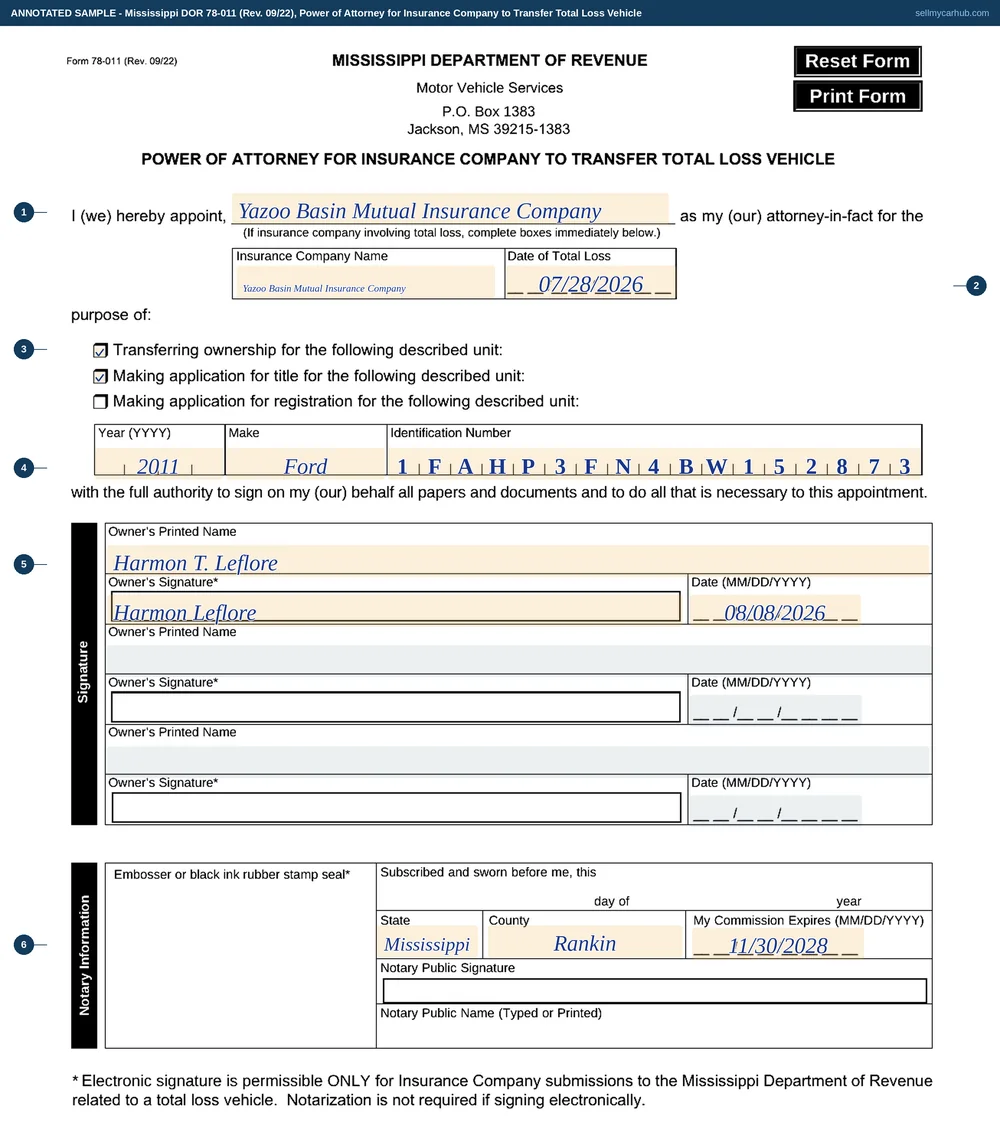
This is the actual 78-011, rendered from the PDF the Mississippi Department of Revenue, Motor Vehicle Services publishes and completed end to end: letterhead, every field, and the blocks at the foot.

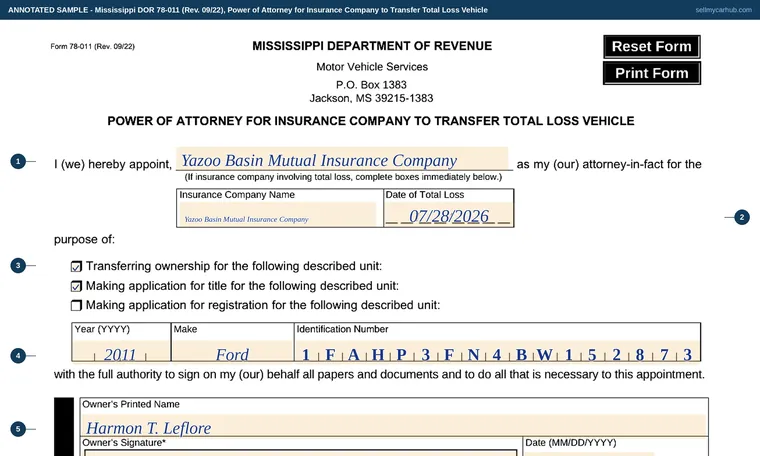
A Mississippi Form 78-011 filled in: Harmon T. Leflore appoints Yazoo Basin Mutual Insurance Company as attorney-in-fact after a total loss dated 07/28/2026 to a 2011 Ford Focus, VIN 1FAHP3FN4BW152873, with the transferring-ownership and making-application-for-title purposes ticked, the owner's printed name, signature and date completed in the first lane, and the notary section completed with state and commission expiry.
The actual 78-011 at Rev. 09/22, granted for one flood-damaged sedan. The two ticked purposes are the claim's whole business - transfer and title - and registration is deliberately left unticked, because the insurer has no business registering anything in the owner's name. Paper copy, so the notary block at the foot is completed; the form's own asterisk reserves the no-notary shortcut for the insurer's electronic channel.
Field by field

Every line, in the order you meet it

  1. 1
    You fill this in

    The insurer, named as your attorney

    The company's name into the appointment line, its name again with the date of total loss in the boxes beneath.

    Watch out: The date of total loss comes from the claim, not from memory - it is the date the salvage machinery reads from.

  2. 2
    You fill this in

    The purpose ticks, no more than needed

    Tick transferring ownership and making application for title; leave registration unless the claim genuinely requires it.

    Watch out: A power of attorney is measured by its ticks. Grant the two the settlement needs and keep the third.

  3. 3
    You fill this in

    The vehicle line

    Year, make and the full identification number of the totalled unit.

    Watch out: Fill it yourself before signing - an open vehicle line on a signed power is the one blank on this page worth being paranoid about.

  4. 4
    You fill this in

    Every owner, every lane

    Printed name, signature and date for each owner the certificate carries.

    Watch out: A co-owned car needs the co-owner's lane completed too, and the insurer will bounce the packet otherwise - their seventy-two-hour clock makes them fussy, not lenient.

  5. 5
    Somebody else fills this in

    Notary, unless the insurer goes electronic

    On paper, the notary seals, dates and signs with commission expiry. Electronically, the footnote waives it - for insurance company submissions only.

    Watch out: If an adjuster tells you no notary is needed, that is true of their channel, not of a paper form in your envelope. When in doubt, swear it.

At a glance

What goes where

On the formWhat to put in it
The appointmentI (we) hereby appoint (name) as my (our) attorney-in-fact - with the bracketed instruction that an insurance company total loss completes the boxes immediately below: insurance company name and date of total loss.
The purpose ticksThree checkable purposes: transferring ownership for the described unit, making application for title for it, and making application for registration for it.
The vehicleYear (YYYY), make and identification number - one line, one unit.
The signature blockThree repeating lanes of owner's printed name, owner's signature and date (MM/DD/YYYY) - room for every owner the certificate names.
The notary sectionEmbosser or black ink rubber stamp seal, subscribed and sworn before me with day and year, state, the notary public's signature, printed name and commission expiry.
The electronic-signature footnoteThe asterisk under everything: electronic signature is permissible ONLY for insurance company submissions to the Mississippi Department of Revenue related to a total loss vehicle - and notarization is not required if signing electronically.

What gets this one rejected

Rules that decide whether it is accepted

Every line here was read off 78-011 (Rev 09/22) itself — the PDF is here — and off the Mississippi Department of Revenue, Motor Vehicle Services pages. This is plain-language help with a form, not legal advice, and where our wording and the agency's differ, theirs governs.

Back to all Mississippi seller paperwork, or what selling a car in Mississippi involves.

Want the paperwork handled instead?

Get My Instant Offer → Online · about 2 minutes · free

Or send the details — we'll come to you

Insurer totalled the car but you would rather keep it and sell? That is the owner-retained path, and we buy those - ask before you sign anything over.

or call/text (877) 405-1808