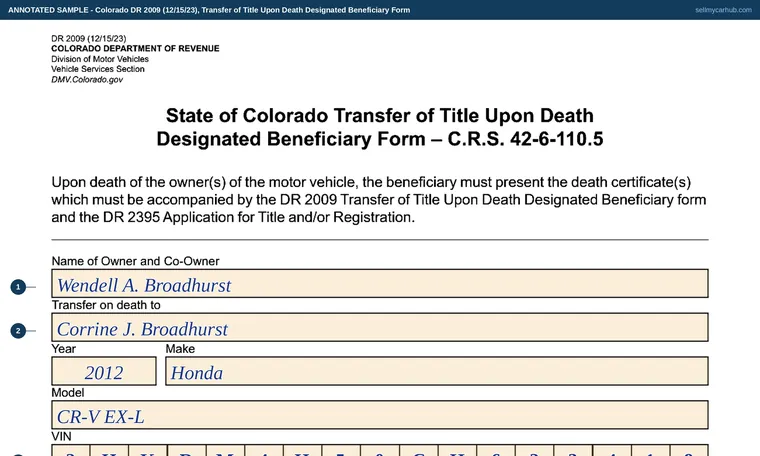
Ten fields that turn a vehicle into a thing that passes outside probate. The owner completes it while alive and it sits with the certificate of title doing nothing; on death, the beneficiary presents the death certificate with this form and an ordinary title application, and the vehicle moves. It is also the one document the department names as a substitute for letters of testamentary or administration, but only where the owner filled it in beforehand.
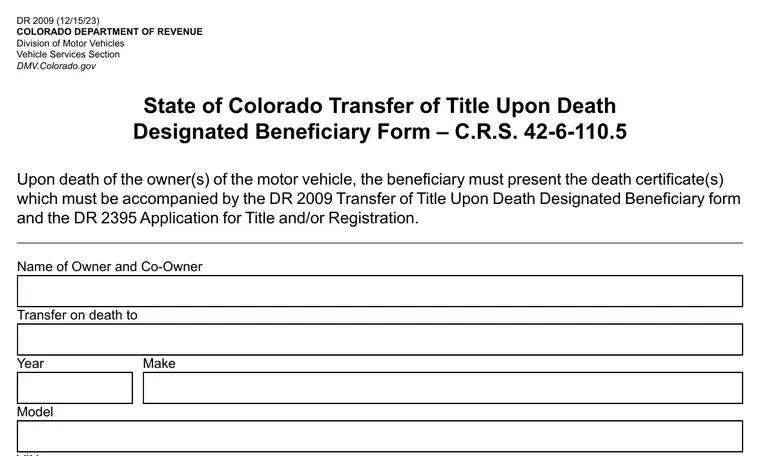
Written against DR 2009 (12/15/23), issued under C.R.S. 42-6-110.5. This form is worth ten minutes to anyone selling a car late in life, because the alternative for the family is a court appointment. It is not something a buyer or an heir can put right after the fact.
Two documents, and they are not the same thing. Take the blank DR 2009 from the dmv.colorado.gov copy so you get the revision that is current today.
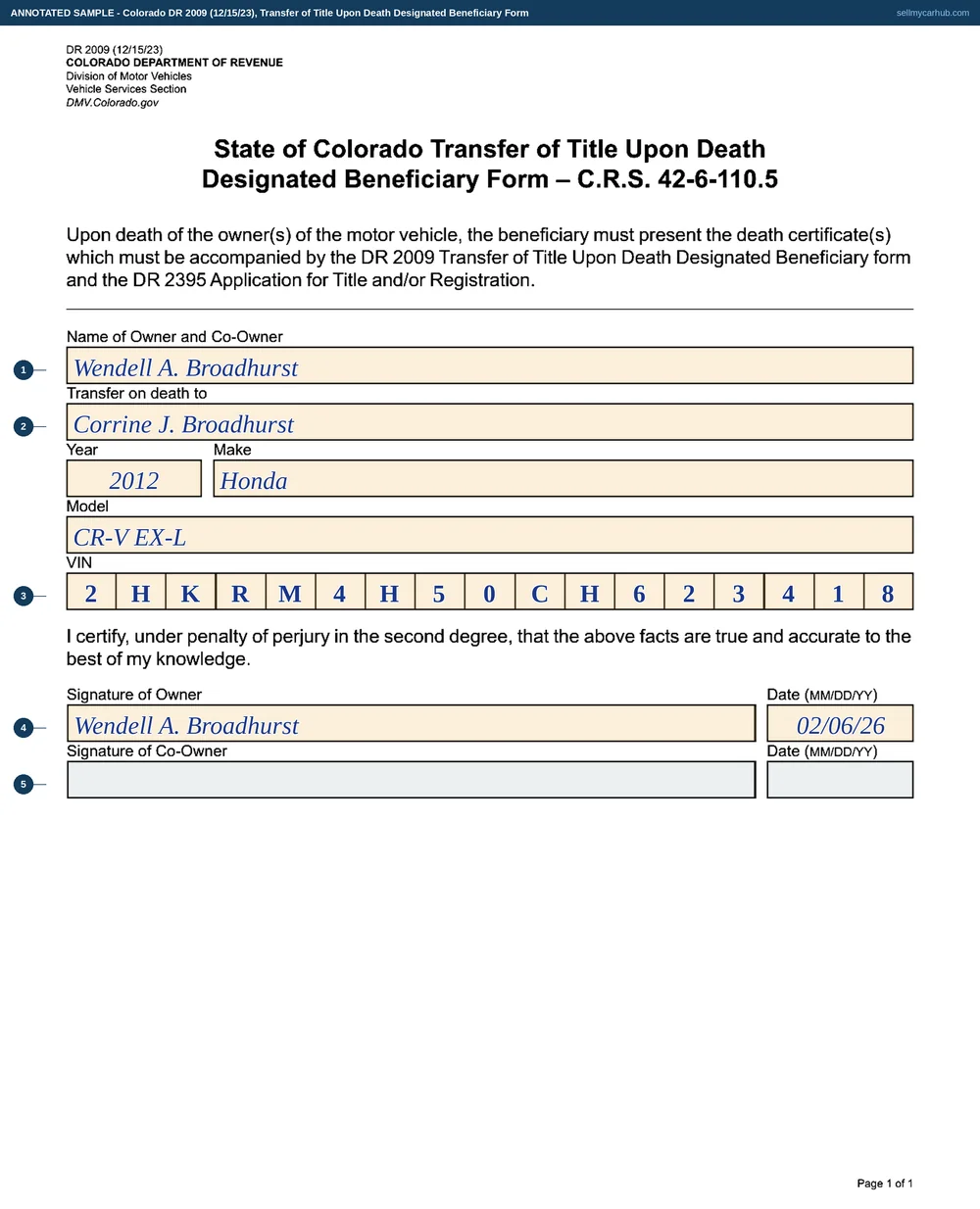
This is the actual DR 2009, rendered from the PDF the Colorado Department of Revenue, Division of Motor Vehicles publishes and completed end to end: letterhead, every field, and the blocks at the foot.
The owner or owners exactly as the face of the certificate of title prints them.
Watch out: If the certificate names two people, both are designating and both sign. A designation by one owner of a jointly held vehicle does not do what it looks like it does.
The beneficiary, one name, on one rule.
Watch out: Spell it the way their identification spells it. The beneficiary will be applying for title in that name and a mismatch means a statement of one and the same on top of everything else.
The vehicle, across three rules.
Watch out: Copy the identification number from the certificate. This designation attaches to one vehicle and does not follow you into the next one.
Under the certification made under penalty of perjury in the second degree.
Watch out: Then put it with the certificate of title, not with the will. The beneficiary needs to be able to find it alongside the document it refers to.
The second row, used only where the certificate names two owners.
Watch out: Leave it empty rather than having a spouse who is not on the title sign it. A signature from somebody with no interest in the vehicle proves nothing.
| On the form | What to put in it |
|---|---|
| Name of Owner and Co-Owner | One rule, covering both where a certificate names two. |
| Transfer on death to | The beneficiary. One rule, and there is no room for alternates or for a share split. |
| Year and Make | Two boxes on one rule. |
| Model | Its own rule. |
| VIN | Its own rule under the model. |
| The certification | One sentence certifying under penalty of perjury in the second degree that the above facts are true and accurate to the best of the owner's knowledge. |
| Signature of Owner and Date (MM/DD/YY) | The owner's row. |
| Signature of Co-Owner and Date (MM/DD/YY) | The second row, for a certificate issued to two people. |
| The instruction across the top | Upon death of the owner(s), the beneficiary must present the death certificate(s), accompanied by this form and the DR 2395 Application for Title and/or Registration. |
Every line here was read off DR 2009 (12/15/23) itself — the PDF is here — and off the Colorado Department of Revenue, Division of Motor Vehicles pages. This is plain-language help with a form, not legal advice, and where our wording and the agency's differ, theirs governs.
Back to all Colorado seller paperwork, or what selling a car in Colorado involves.