Everything a private Colorado seller does happens in one block on the back of one sheet. The block is headed Assignment by Owner(s), it has four seller rows and a column of buyer fields beside them, and directly above it sits the sentence that replaced the notary: the seller certifies, under penalty of perjury in the second degree, that the signature releases and transfers interest in the vehicle and that the odometer reading and declaration are true and correct.
As a private seller you complete these and nothing else:
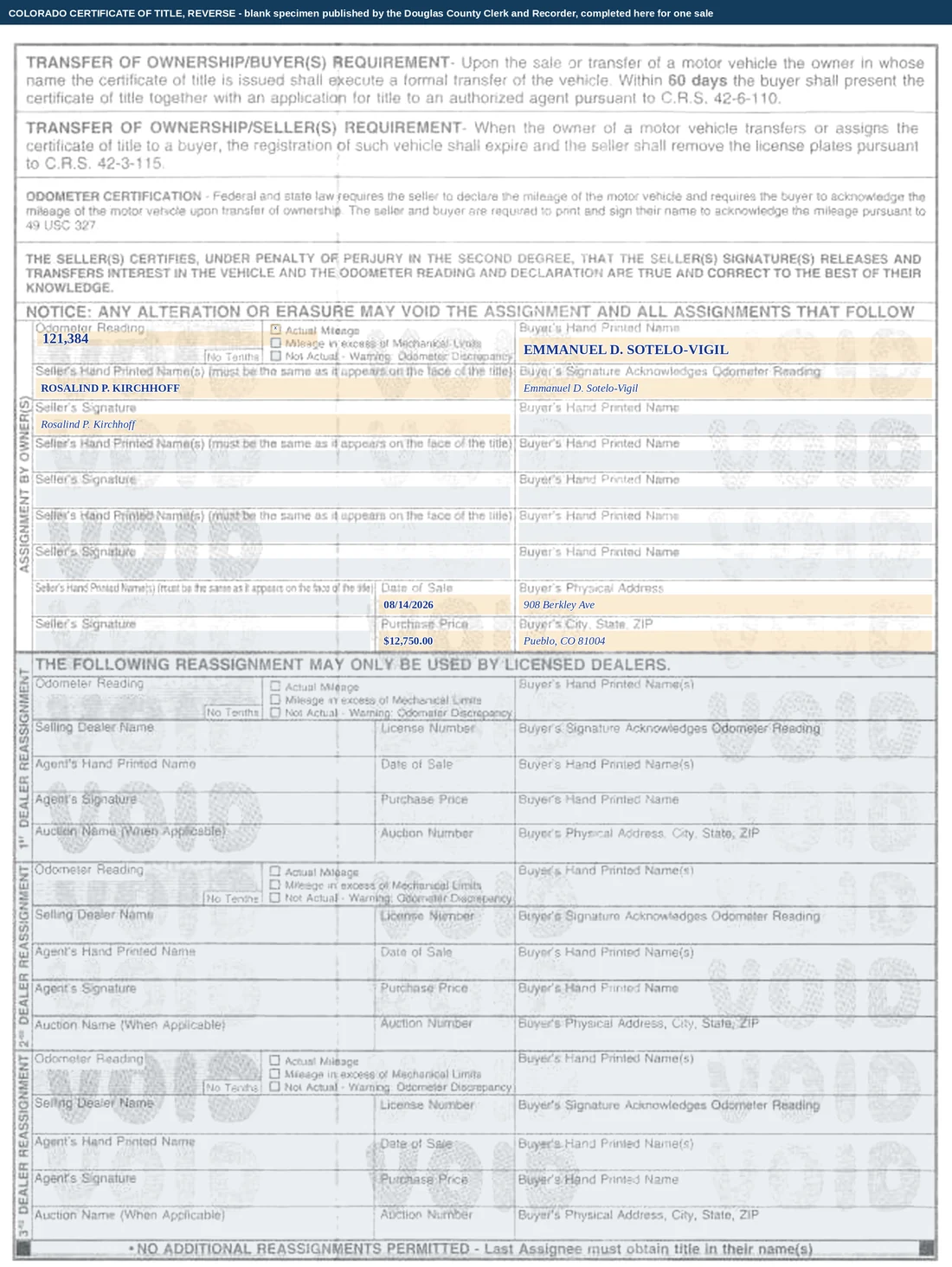
You cannot download a Colorado title and there is nothing to rehearse on. The certificate is secure stock, printed by the county or the state and posted to the owner or the lienholder. What is below is a genuinely blank reverse of one, published by a county clerk in the packet it hands to dealers, with our sample sale written into it - the word VOID standing across it is on the sheet the county published, not something added here.
NOTICE: ANY ALTERATION OR ERASURE MAY VOID THE ASSIGNMENT AND ALL ASSIGNMENTS THAT FOLLOW
The block names below are transcribed from the certificate itself and from the itemised list of required fields in the Douglas County Clerk and Recorder's Colorado Dealer Packet, which is the training document the department's authorized agents work from.
Not a drawing. This is the blank reverse of a Colorado Certificate of Title exactly as the Douglas County Clerk and Recorder publishes it in the packet it hands to dealers - no owner, no vehicle, no data of any kind on it - with our sample sale written into the Assignment by Owner block and everything a private seller must not touch washed grey.
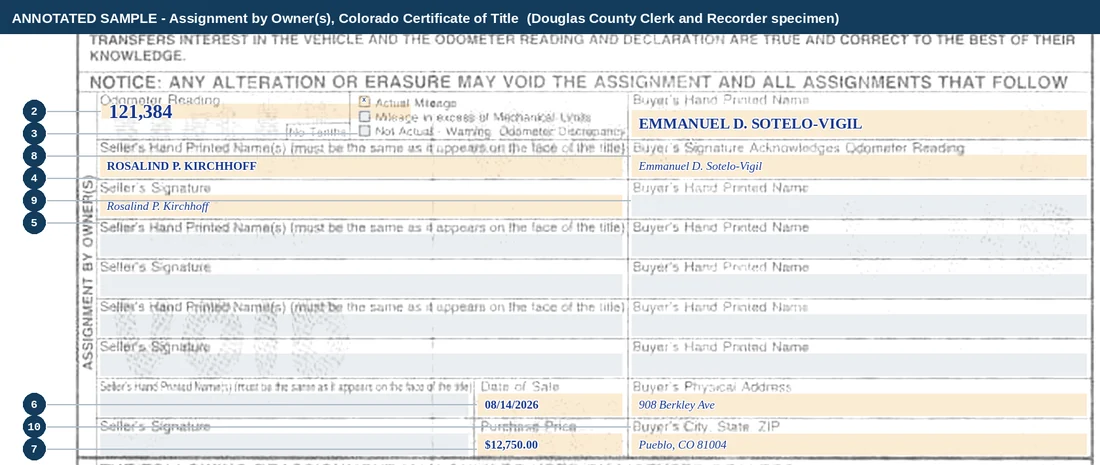
The block runs the full width of the certificate, which makes it small on a phone. Here it is on its own. The numbers in the gutter match the numbered steps further down the page.
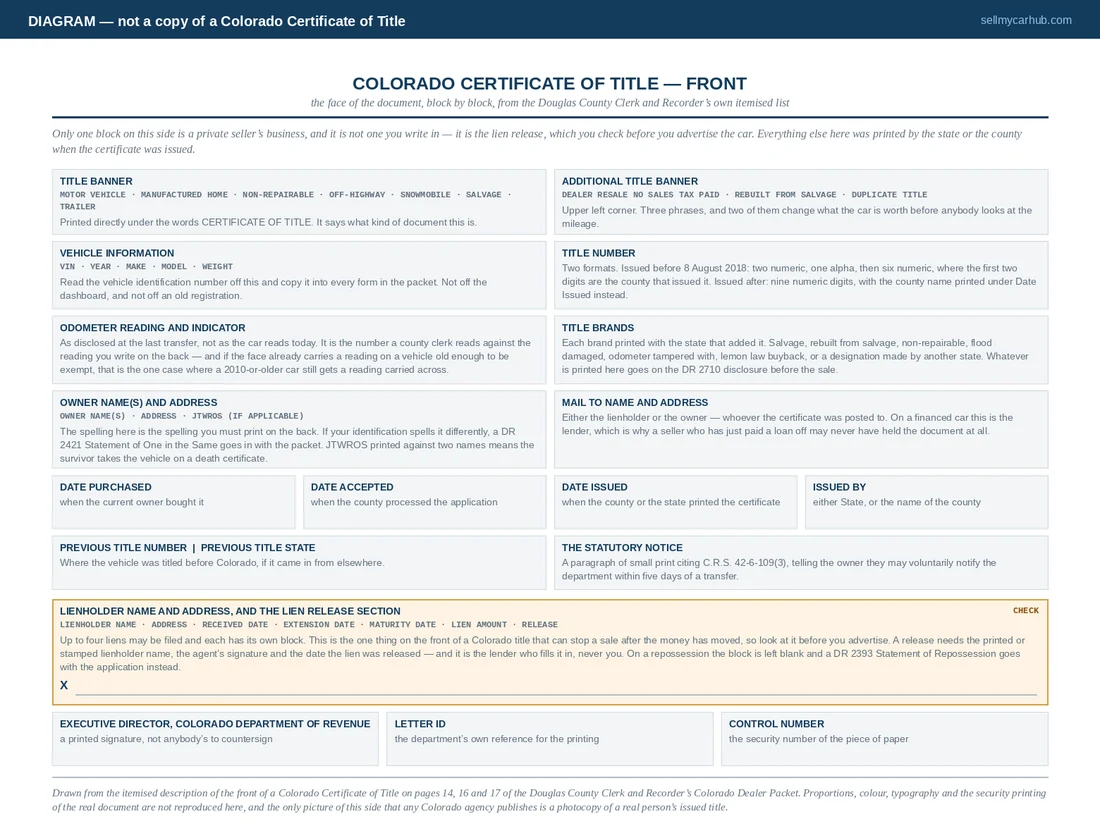
The owner names as the face of the certificate prints them, the conjunction between them, and whether the lien release section on the front has been signed and dated.
Watch out: Your printed name in the assignment has to match the face of the title. First initial and last name is not acceptable for the seller or the seller's agent, and a mismatch needs a DR 2421 travelling with the paperwork.
The current reading in whole miles, in the field marked No Tenths at the top left of the Assignment by Owner block.
Watch out: This is the one box on a Colorado title with no second chance. An alteration of the odometer reading in the Assignment by Owner section voids the document and the fix is a duplicate title, unless the vehicle is 2010 or older and can be exempted with a statement of fact.
One tick, in one of three boxes - Actual Mileage, Mileage in excess of Mechanical Limits, or Not Actual - Warning: Odometer Discrepancy.
Watch out: Required whenever a reading is entered, and the third box is not a shrug. It writes a permanent discrepancy onto the buyer's certificate and every certificate issued after it.
Printed, not signed, and the field label carries its own instruction in brackets: must be the same as it appears on the face of the title.
Watch out: If the title is in a business name, the person printing here is the agent and the business name goes with it. If a power of attorney is being exercised, the agent prints their own name, not the owner's.
Directly under the printed name. Every owner the front of the certificate names needs a row of their own, and the block gives four.
Watch out: Sign in ink and sign once. The declaration you are signing under is the perjury sentence printed above the block, not a notary's seal - there is no seal on a Colorado title and nowhere to put one.
The day the keys actually changed hands, in the field on the fourth seller row.
Watch out: This date starts the buyer's sixty-day clock and, if you file one, dates your report of transfer. Post-dating it to help a buyer who is not ready is a false statement on a document you have just sworn to.
What was actually paid, in the field under the date of sale.
Watch out: Leave it out and the county needs a bill of sale instead, because the price is what the sales tax is calculated on. Write a low number to help the buyer and you have signed a false declaration to save somebody 2.9 per cent plus local.
In the right-hand column of the block, printed as it appears on their secure and verifiable identification.
Watch out: Their name has to match their identification exactly or they need their own DR 2421. A nickname, a maiden name or a doing-business-as will stop the application at the counter.
One line, acknowledging the mileage you have just certified.
Watch out: Only one buyer signature is required even where two buyers are printed. It is federal rather than a Colorado flourish, which is why the paragraph above it cites 49 USC 327.
Where the buyer actually lives, in the last two fields of the buyer column.
Watch out: This decides which county takes the application and which local sales tax rate applies. A post-office box or an old address sends the paperwork to the wrong counter and costs the buyer money.
First, second and third dealer reassignment, each with a selling dealer name, a licence number, an agent's printed name and signature, and an auction name and number.
Watch out: A private seller who fills one of these in has used the wrong block on the right document. The band above them reads THE FOLLOWING REASSIGNMENT MAY ONLY BE USED BY LICENSED DEALERS, and the foot of the sheet says no additional reassignments permitted.
Plates off the car, an emissions certificate handed over if the buyer is in the programme area, and a release of liability filed through myDMV.
Watch out: The plates expire the instant you assign the title, so they cannot go on your next car and there is nothing to gain by leaving them. Return them to a county office or recycle the metal.
Six things to settle before the pen comes out, and the first one costs you a duplicate title if you get it wrong.
| Check the lien release section on the front first | It is on the face of the certificate and the lienholder fills it in. A blank release block means the payoff never reached the record, and the buyer's county will reject the application whatever your bank told you on the telephone. |
|---|---|
| Get the odometer field right the first time | Alteration of the odometer reading in the Assignment by Owner section voids the document. Not the line, the document - and the remedy is a duplicate title bought by you before the sale can be completed. |
| Print the name the title prints, not the name you use | The department's instruction is that the seller must print their name as it appears on the title, and that a first initial with a last name is not acceptable from a seller or a seller's agent. |
| Decide where the price is going before you start | The date of sale and the purchase price must be written on the back of the title unless a separate bill of sale is also included. Picking one and doing it properly beats discovering at the counter that you did neither. |
| Buy the emissions test before the handover, not after | In the programme area the seller provides the passing test, and it has to be one that has not already been used to register or renew a vehicle. There is no way to hand over a certificate you have already spent. |
| Have a screwdriver in your pocket | The plates are yours and they expire the moment you assign the title. Taking them off is part of the handover, not an errand for the following week. |
The ink rule is the Division of Motor Vehicles' own: “NOTICE: ANY ALTERATION OR ERASURE MAY VOID THE ASSIGNMENT AND ALL ASSIGNMENTS THAT FOLLOW” — Douglas County Clerk and Recorder, Colorado Dealer Packet, pages 13 to 17.
Four things Colorado sellers repeat to each other that the department contradicts in writing. Each answer links the source.
“Take it down to the DMV and they will transfer it.”
The Division of Motor Vehicles will not, and cannot. Counties handle most title and registration transactions for personal vehicles, they work independently under their elected county clerks and recorders, and the department's own page says that State driver license offices and the State DMV Vehicle Services office cannot perform these services. It also has to be the buyer's county: other counties' motor vehicle offices will not be able to provide services.
“Get the title notarised so it holds up.”
There is no acknowledgement block on a Colorado certificate of title and nowhere to put a seal. The statute asks the registered owner to affirm the sale accompanied by a written declaration that the statement is made under the penalties of perjury in the second degree, and the certificate prints that sentence above the block you sign. A notary adds nothing and a notary's stamp in the wrong place is an alteration.
“Keep the plates, they go on the next car.”
Half right, and the expensive half is wrong. The plates do come off - they are tied to the registered owner, not the vehicle. But since 1 January 2022 an ordinary passenger plate expires when you assign the title and shall not be transferred by the department to any other motor vehicle. Only personalised and special plates move. Regular ones go back to a county office or into the metal recycling.
“You have five days to report the sale or you are liable.”
Five business days is right and the obligation is not. The statute that created the report says it does not require the owner who transfers a motor vehicle to another person to report the sale. Filing is worth doing because it buys you protection from actions brought against the operator and against the vehicle - but a seller who never files has not broken a rule, and a seller who has delivered possession and a properly endorsed certificate is already protected from damages resulting from negligent operation by another.
Fewer signatures than most states ask for, and not one of them witnessed:
| Every owner printed on the face | The certificate gives four Seller's Hand Printed Name rows and four Seller's Signature rows underneath them. Two owners means two of each, and the printed name has to match the face of the title character for character. |
|---|---|
| Nobody as a witness | There is no witness line and no acknowledgement block on the back of a Colorado title. The witness signature people remember is on the DR 2395 application, which the buyer files, not on the certificate. |
| No notary, at any point | There is no acknowledgement block, no seal box and no commission line anywhere on either face of the certificate. Where a notary does appear on Colorado motor-vehicle paper it is on a power of attorney or a small-estate affidavit, never on the assignment. |
| The buyer, exactly once | One Buyer's Signature Acknowledges Odometer Reading line, and the note in the county clerks' own dealer packet is that only one signature is required to acknowledge the odometer even where two buyers are printed. |
| An agent, only with the original power of attorney | A copy will not move ownership. The DR 2175 says the original power of attorney must be surrendered to transfer ownership and acknowledge the odometer reading. |
| Not a dealer, in your block | The three blocks beneath yours are dealer reassignments, each with a licence number line, and the band across them says they may only be used by licensed dealers. |
The assignment is the whole of your job on the document. What is left is physical: the plates off the car, a photograph of the completed back, and a release of liability filed the same evening even though nobody makes you.
The two things that follow a signed title — what happens to the plates and telling the Division of Motor Vehicles the car is gone — are set out in full on the Colorado paperwork page rather than repeated here.
The forms that go with it: the DR 2395, which the buyer files, the DR 2421, if your name is spelled two ways and the DR 2444, if something on the assignment went wrong.
Every field description here is taken from the Douglas County Clerk and Recorder, Colorado Dealer Packet, pages 13 to 17 and the Colorado Department of Revenue, Division of Motor Vehicles title pages, current as of 2026-08-23. Plain-language help with a form, not legal advice, and where our wording and the agency's differ, theirs governs.
Back to all Colorado paperwork, or what selling a car in Colorado involves.